
Pilots
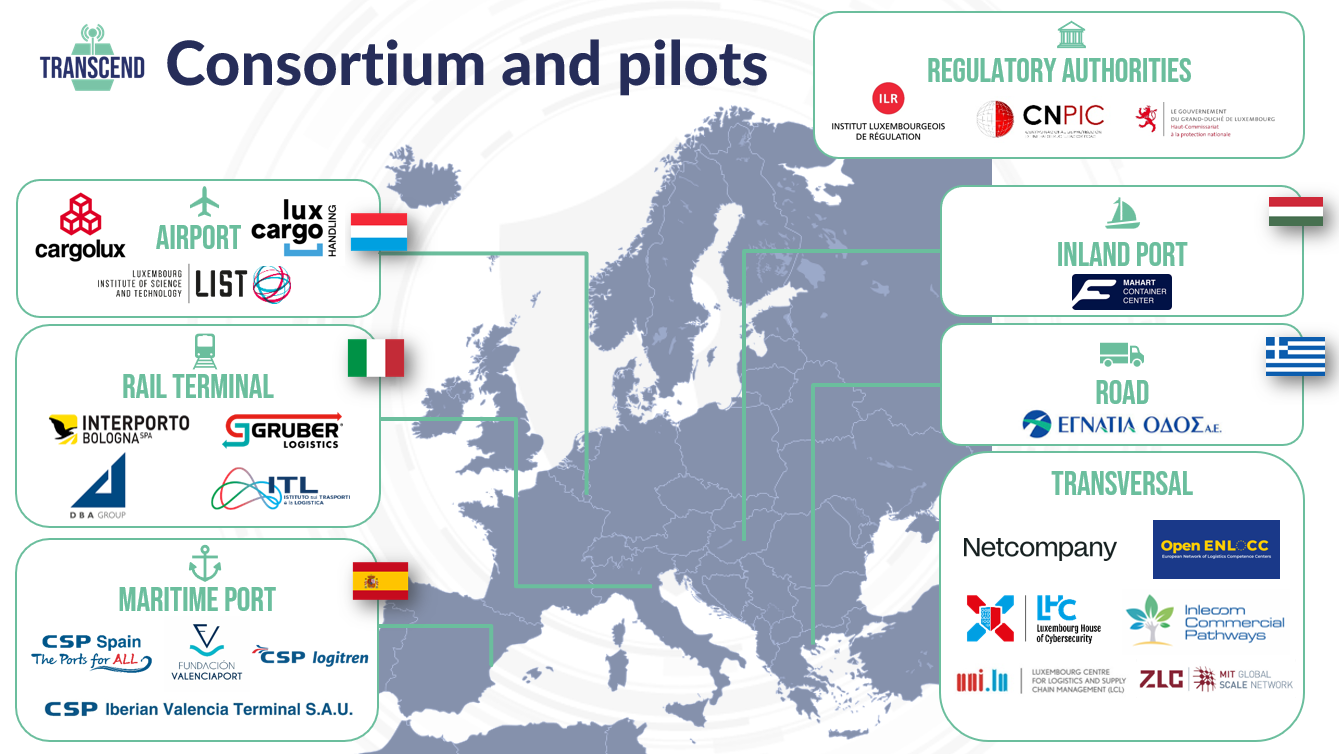
In the framework of the TRANSCEND project, three real-world pilot tests will be implemented by the project consortium in three different countries: the airport pilot in Luxembourg, the rail-road terminal pilot in Bologna, Italy and the trimodal port pilot implementation in Spain; and 2 transferability demonstrators: the fluvial port of Budapest and the Egnatia’s highways in Greece.
Luxembourg
Airport pilot implementation
As part of the Luxembourghish pilot, Cargolux will develop an operational procedure based on industry standards, best practices and possible regulations relating to anti-crime programmes that would foster the implementation of security checks on people, belongings and vehicles exiting cargo centres.
Main activities
- Investigate and test physical / cyber threat detection technologies
- Identify best practices and/or regulatory requirements deployed in the intermodal supply chain that is used today to implement security checks for people, belongings and vehicles entering and leaving a Cargo Center (or the airside of an airport)
- Explore technical solutions that are being used or could be used to passively mark or identify high-value goods so that they could be detected when leaving a Cargo Center through non-normal exit paths (passive tags, geofencing…)
- Conduct an analysis that would allow the improved control of movements of these goods into, out of or even within the Cargo Center, which is cost-effective and could bring additional operational benefits
- Perform a number of trials to ensure the effectiveness of the solutions in a complex environment like a very busy Cargo Center during peak times/periods
- Identify the best and most promising solutions, integrating technologies that are in development
- Implement a Control Tower for high risk/high value goods integrity monitoring
- Test emergency plan and behaviour attitude (Exercise in Room #42)
Bologna
Rail-road terminal pilot implementation
The Bologna pilot will evaluate existing technological solutions that could improve the management efficiency of the freight village. With the support of DBA, the objective of this task is to analyse existing software solutions that could also resolve the actual problems of the intermodal node. Furthermore, the Bologna pilot will evaluate integration solutions to allow the data integration of both Interporto Bologna and Gruber Logistics within the Control Tower.
Main activities
- Investigate and potentially test physical / cyber threat detection technologies
- Together with DBA, IPBO will develop a cybersecurity procedure common to all operators working on the rail terminal and in the warehouses (then including GRU).
- Analyse the existing security procedures of GRU and IPBO
- Create a joint document that includes the security procedures of IPBO and GRU to harmonise the operational security activities within the freight village area
- Implement a Control Tower for a regional orchestration between operators
- Test emergency plan and behaviour attitude (Exercise in Room #42)
Spain
Trimodal port pilot implementation
In order to improve the resilience of the multimodal transport between Valencia and Zaragoza, the innovative technologies identified and developed during the project related to physical/cyber threat detection will be analysed to be used by the different companies participating in the supply chain.
Main activities
- Investigate and potentially test physical / cyber threat detection technologies
- Create a joint document that includes the security procedures to harmonise the operational physical and cyber security activities across the multimodal transport supply chain
- Implement a Control Tower to monitor security incidents in multimodal transport
- Test emergency plan and behaviour attitude (Exercise in Room #42)